What is Contact Center as a Service (CCaaS)?
Contact Center as a Service (CCaaS) is a cloud-based solution that enables businesses to operate customer support and engagement functions without maintaining on-premise infrastructure. Instead of managing physical telephony systems, organizations rely on CCaaS platforms hosted and maintained by cloud contact center providers.
From a business perspective, CCaaS simplifies operations and reduces costs. From a technical standpoint, it delivers customer interactions through web-based interfaces supported by scalable cloud architecture and AI-driven automation.
CCaaS Deployment Models Explained
While CCaaS is commonly described as a cloud-based solution, the underlying deployment model plays a critical role in performance, security, and compliance.
Common Contact Center as a Service deployment models include:
- Multi-tenant CCaaS – Shared infrastructure with logical data separation, suitable for fast-growing businesses prioritizing speed and cost efficiency.
- Dedicated CCaaS – Isolated virtual machines or environments designed for enterprises with strict security, data privacy, or compliance requirements.
- Hybrid CCaaS – A combination of cloud-based contact center services with selective on-premise or private cloud integrations.
Understanding these deployment models allows businesses to select CCaaS platforms that align with operational scale, regulatory needs, and long-term growth strategies. Platforms like ConVox support flexible CCaaS deployment options, enabling organizations to balance scalability, control, and compliance without architectural complexity.
Why CCaaS Matters in 2026
Customer expectations have evolved. Users expect instant responses, channel flexibility, and personalized conversations. Traditional contact centers struggle to meet these demands due to rigid infrastructure and limited scalability.
CCaaS addresses this gap by offering:
- Rapid deployment through cloud-based infrastructure
- On-demand scalability during high interaction volumes
- Intelligent handling of customer interactions using AI-driven automation
Technically, CCaaS platforms leverage distributed systems to ensure high availability and performance. Strategically, they allow businesses to focus on customer experience instead of infrastructure management.
How Contact Center as a Service Works
A CCaaS platform operates entirely in the cloud. Agents access the system via secure web applications, while supervisors monitor performance using real-time analytics dashboards.
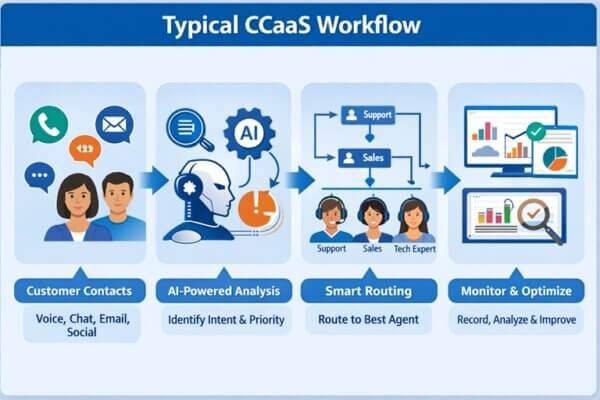
The typical CCaaS workflow includes:
- Customers connect via voice or digital channels
- AI-driven automation identifies intent and priority
- Intelligent routing assigns interactions to the right agent
- Conversations are recorded, analyzed, and optimized
This architecture ensures efficient customer interactions while maintaining system stability and performance.
Key Features of CCaaS
Modern Contact Center as a Service platforms are built to support both operational efficiency and advanced customer engagement.
Omnichannel Customer Engagement
CCaaS unifies voice, email, chat, messaging apps, and social platforms into a single interface, ensuring continuity across all customer interactions.
AI-Driven Automation
AI-powered IVR, chatbots, sentiment analysis, and predictive routing reduce manual effort while improving response accuracy and speed.
Intelligent Call & Interaction Routing
Interactions are routed based on skills, customer history, intent, and real-time availability, improving first-contact resolution.
Real-Time Analytics and Monitoring
Supervisors gain access to performance metrics, call quality data, and interaction insights for informed decision-making.
Secure Cloud Infrastructure
Leading cloud contact center providers offer encryption, compliance readiness, and high uptime to protect customer data.
CCaaS vs Hosted Contact Centers
CCaaS is often confused with hosted contact center solutions. While both are vendor-managed, their architecture and long-term value differ significantly.
| Feature | Hosted Contact Center | CCaaS |
| Infrastructure | Vendor-hosted legacy systems | Cloud-native architecture |
| Scalability | Limited | On-demand |
| AI-driven automation | Minimal | Built-in |
| Platform updates | Manual or delayed | Continuous |
| Innovation speed | Slow | Rapid |
Contact Center as a Service is designed for continuous optimization and rapid innovation, whereas hosted contact centers are typically modernized versions of traditional systems. ConVox’s CCaaS architecture is built cloud‑native from the ground up, allowing businesses to adopt new channels, AI capabilities, and workflows without platform limitations.
Benefits of Contact Center as a Service
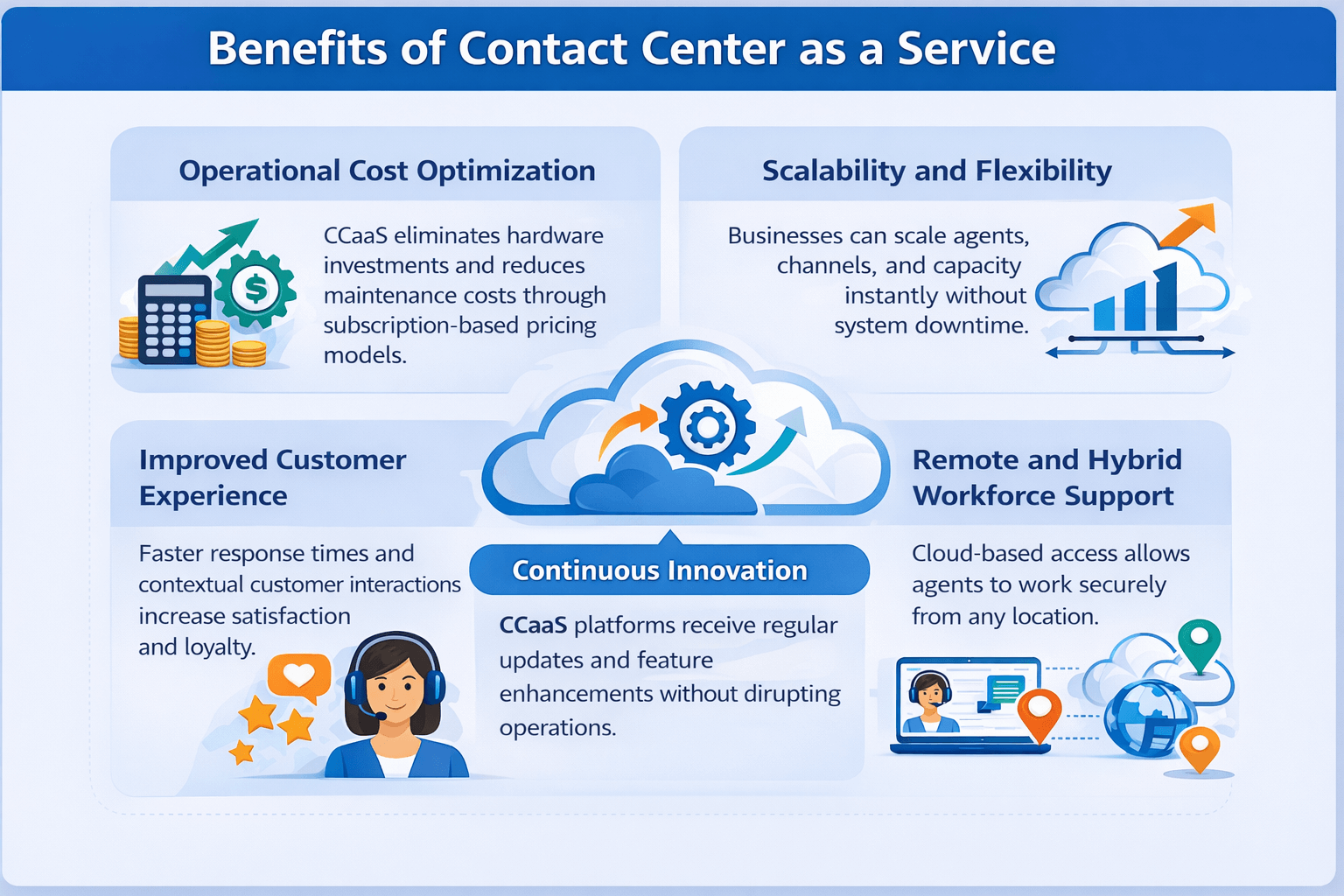
Operational Cost Optimization
CCaaS eliminates hardware investments and reduces maintenance costs through subscription-based pricing models.
Scalability and Flexibility
Businesses can scale agents, channels, and capacity instantly without system downtime.
Improved Customer Experience
Faster response times and contextual customer interactions increase satisfaction and loyalty.
Remote and Hybrid Workforce Support
Cloud-based access allows agents to work securely from any location.
Continuous Innovation
CCaaS platforms receive regular updates and feature enhancements without disrupting operations.
AI Maturity Levels in CCaaS Platforms
Not all Contact Center as a Service platforms use AI in the same way. Understanding AI maturity helps businesses evaluate long-term value.
AI maturity in CCaaS typically progresses through:
- Rule-based automation – Basic IVR systems and predefined routing logic
- Assisted AI – Agent assistance, sentiment analysis, and real-time suggestions
- Predictive AI – Intent prediction, behavior-based routing, and proactive engagement
- Autonomous AI – Self-service resolution and continuous optimization without human intervention
Evaluating CCaaS platforms based on AI maturity ensures businesses invest in future-ready customer engagement systems. ConVox aligns with higher AI maturity stages, combining assisted and predictive AI to optimize routing, automate interactions, and continuously improve customer experience outcomes.
Selecting the Right Cloud Contact Center Provider
When evaluating CCaaS platforms, businesses should assess:
- Platform reliability and uptime guarantees
- AI-driven automation maturity
- Omnichannel support depth
- Security, compliance, and data isolation
- Integration capabilities with CRM and business tools
Experienced cloud contact center providers offer configurable CCaaS solutions that align with both technical requirements and business objectives.
Final Thoughts
Contact Center as a Service is no longer optional for businesses focused on scale and customer experience. At Deepijatel, CCaaS is viewed as a strategic foundation for building resilient, scalable, and intelligence-driven customer engagement operations. By combining cloud-based architecture, AI-driven automation, and intelligent engagement tools, CCaaS enables organizations to deliver reliable, efficient, and future-ready customer interactions.
As customer expectations continue to evolve, CCaaS will remain the foundation of modern contact center operations. Deepijatel continues to align cloud-first architecture, AI-driven automation, and enterprise-grade reliability to support future-ready contact center transformation.